
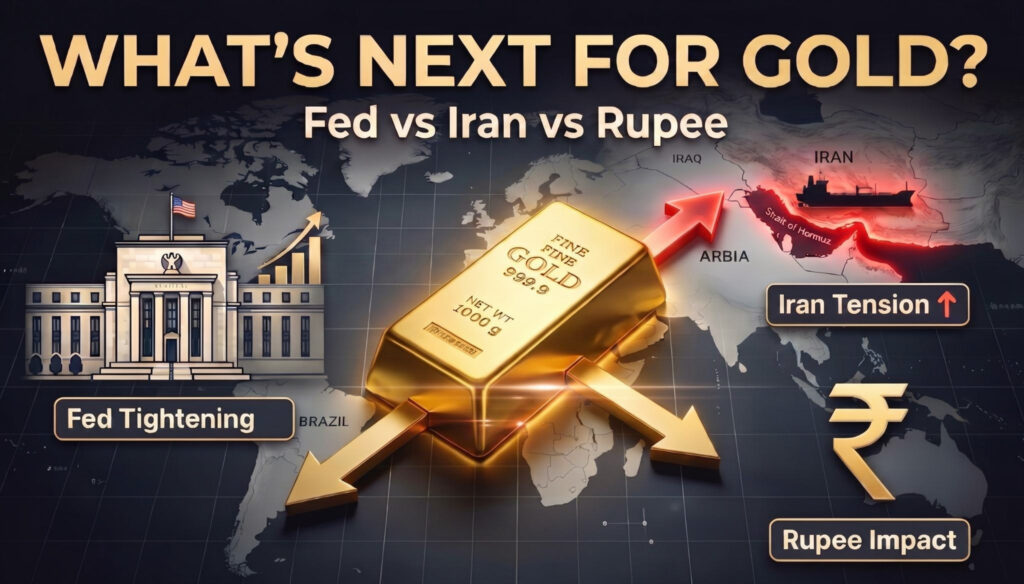
The bullion market faces competing forces: US–Iran tensions at the Strait of Hormuz provide geopolitical support, while a stronger dollar, elevated Treasury yields, and prolonged Fed rate tightness suppress prices. Gold recovered modestly to $4,700 after diplomatic signals emerged. The Fed’s April 29 decision remains the critical macro trigger. India’s rupee weakened to ₹94/dollar amid rising crude costs. Central banks globally continue accumulating gold, though at a slower pace. Institutional ETF demand stays structurally strong.
——————————————————————————————————————-
The dominant market driver last week was the intensifying US–Iran conflict centred on the Strait of Hormuz. Iran restricted commercial shipping through the waterway and allegedly attacked foreign vessels. The US, in turn, blockaded Iranian ports — a move Iran labelled a ceasefire violation. President Trump publicly directed the Navy to engage vessels deploying mines in the strait. Separately, US forces intercepted an Iranian oil supertanker in the Indian Ocean, escalating maritime tensions further.
While such geopolitical disruptions typically strengthen gold’s safe-haven appeal, the bullion market remained constrained. Central banks are maintaining tight monetary policy due to energy-driven inflation, keeping interest rates elevated. This reduces gold’s attractiveness relative to yield-bearing assets. Consequently, a stronger US dollar and persistent rate pressure continue to suppress gold prices despite the geopolitical backdrop.
By Friday, gold recovered modestly, trading above $4,700, reflected cautious optimism following diplomatic signals — Iranian Foreign Minister Abbas Araghchi’s scheduled visit to Islamabad, with Pakistani officials suggesting a meaningful peace breakthrough was probable.
The US Federal Reserve is now projected to hold rates steady through 2026, abandoning earlier expectations of two rate cuts. A rate hike remains a live possibility as policymakers monitor the conflict’s inflationary spillovers. The Fed’s April 29 meeting is now the single most-watched macro event, likely to set gold’s near-term directional bias.
India’s rupee depreciated to approximately ₹94 per dollar, a three-week low, driven by rising crude oil import costs. The currency weakened nearly 1% week-on-week. The Reserve Bank of India intervened by selling dollars to stabilise the exchange rate, but persistent demand from oil importers offset these efforts, keeping the rupee under structural pressure.
Sovereign gold accumulation remained a sustained global trend. Central banks in China, India, Poland, and Turkey continued adding physical gold reserves. January 2026 purchases slowed to 5 tonnes against a 2025 monthly average of 27 tonnes, though demand broadened geographically, with Malaysia and South Korea re-entering the market. Uzbekistan led buying; Russia recorded the largest sales at 9 tonnes. China continued expanding reserves.
Institutional demand remains structurally robust in 2026. A record $89 billion flowed into gold ETFs in 2025, and the SPDR Gold Trust now holds 1,073 metric tons, reflecting significant portfolio realignment toward precious metals. In February, gold ETFs attracted $5.3 billion in fresh inflows, led by North America and Asia, though European funds saw $1.8 billion in net outflows.
China’s silver imports totalled 206.76 tonnes in January–February 2026 — the highest in eight years — tightening global supply and lifting prices. In India, industrial buyers absorbed price dips, providing a floor during speculative sell-offs. Wedding season demand added further consumption-side support, with household jewellery purchases rising across major cities.
Overall sentiment toward bullion remains cautious. A firmer dollar and rising Treasury yields are increasing the opportunity cost of holding gold. The key upcoming catalysts are the Fed’s April 29 rate decision, US Q1 GDP data on April 30, and any definitive progress in US–Iran diplomacy. Each event carries the potential to sharply reverse current price trends.
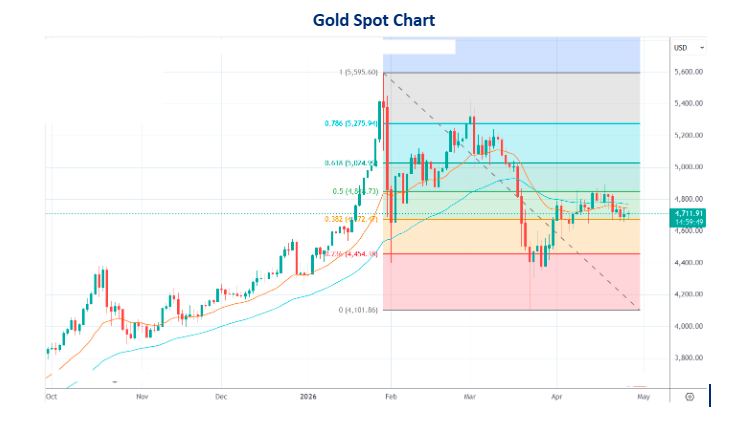
Technically, gold faces resistance at $4,850 (~ ₹1,55,000). A confirmed break above this level could open a path toward $5,000 (~ ₹1,60,000). Immediate support is established at $4,650 (~ ₹1,51,000).
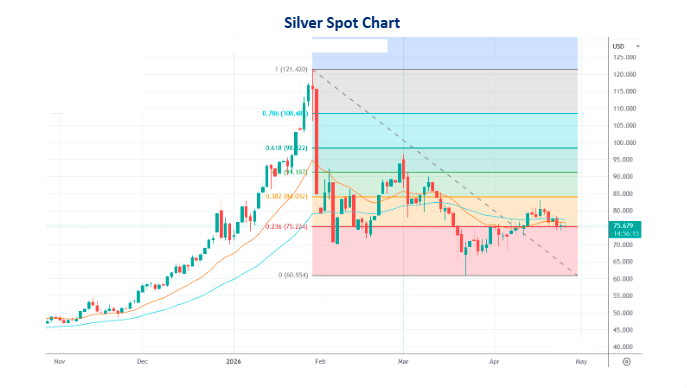
Silver prices are consolidating in the range of $73(~ ₹ 235,000) and $82(~ ₹2,58,000). Either side breakout or breakdown will give further price move.
Disclaimer: This report contains the opinion of the author, which is not to be construed as investment advice. The author, Directors, and other employees of Augmont Goldtech Pvt. Ltd; Augmont Enterprise Private Ltd. and its affiliates cannot be held responsible for the accuracy of the information presented herein or for the results of the positions taken based on the opinions expressed above. The above-mentioned opinions are based on information which is believed to be accurate, and no assurance can be given of the accuracy of the information. The author, directors, other employees and any affiliates of Augmont Goldtech Pvt. Ltd; Augmont Enterprise Private Ltd cannot be held responsible for any losses in trading. In no event should the content of this research report be construed as an express or implied promise, guarantee or implication by or from Augmont Goldtech Pvt. Ltd; Augmont Enterprise Private Ltd., that the reader or client will profit, or the losses can or will be limited in any manner whatsoever. Past results are no indication of future performance. The information provided in this report is intended solely for informative purposes and is obtained from sources believed to be reliable. The information contained in this report is in no way guaranteed. No guarantee of any kind is implied or possible where projections of future conditions are attempted. We do not offer any sort of portfolio advisory, portfolio management or investment advisory services. The reports are only for information purposes and are not to be construed as investment advice.


