Precious metals were caught between two powerful opposing forces last week — a developing US-Iran peace framework that steadily unwound geopolitical risk premium, and a wave of inflationary data that revived rate-hike fears. The combined effect delivered a second straight weekly decline for both gold and silver, though late-session buying in the latter part of the week limited the damage.
Wednesday’s May CPI print was widely expected to breach 4% for the first time in nearly three years, reinforcing the tightening narrative. US producer prices rose 6.5% year-on-year in May — the sharpest reading since November 2022 — laying bare the inflationary footprint of the Middle East energy shock. Core PPI, however, came in at 4.9% year-on-year, meaningfully below the 5.4% consensus, prompting markets to push back their Fed rate-hike expectations from October to December. Fed funds futures subsequently priced a 63.3% probability of a 25-basis-point hike at the October meeting.
The rate-tightening impulse was not confined to the United States. The European Central Bank raised interest rates on Thursday for the first time since 2023, simultaneously revising its inflation projections higher for both 2026 and 2027. The move confirmed what markets had begun to suspect — that the energy shock emanating from the Middle East conflict is not a regional disruption, but a force actively reshaping monetary policy on both sides of the Atlantic.
Gold and Silver staged a recovery at the start of this week after US and Iranian officials announced they had reached an initial agreement to end their conflict. The accord immediately eased pressure on oil prices and dialled back concerns over persistent inflation and further rate increases. Officials from both nations confirmed on Sunday that they had agreed on a framework to end the war, lift the US blockade on Iran, and reopen the Strait of Hormuz — a critical artery for global energy flows.
The formal signing of the agreement is scheduled for this Friday in Switzerland, as confirmed by Pakistani Prime Minister Shehbaz Sharif in a post on X. The announcement sent the US dollar to a 10-day low, making dollar-denominated bullion more accessible to holders of other currencies, while oil prices retreated more than 4%.
The peace deal has since recalibrated Fed rate expectations sharply. According to the CME FedWatch tool, markets have scaled back the probability of a December rate hike to 48%, down from 69% the previous week. Investors are now focused on Wednesday’s Federal Reserve policy decision and commentary — the first under the chairmanship of Kevin Warsh — with rates broadly expected to remain on hold.
Underlying demand drivers for gold remain structurally intact. Currency debasement concerns, elevated fiscal risks, and deepening geopolitical fragmentation continue to support long-term allocations. A sustained moderation in energy-driven inflation could allow these themes to reassert themselves more forcefully in the months ahead.
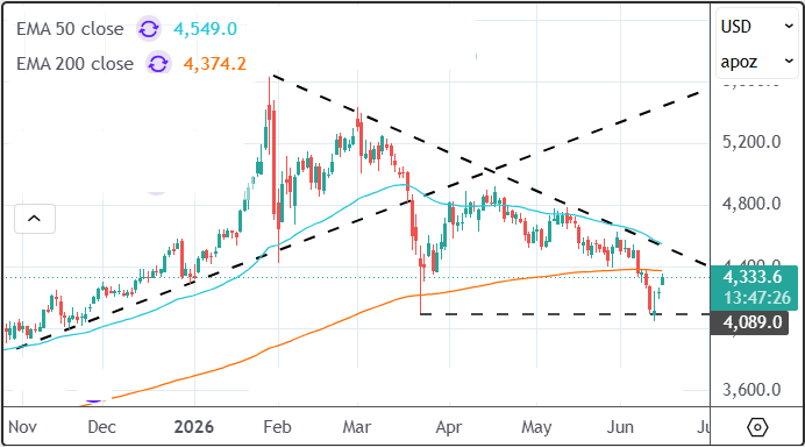
Gold is currently trading near $4330, with bullish momentum building on the back of the US-Iran agreement. Key resistance is clustered at $4500–$4550, breaking this level, would give Gold new bullish wings, while support holds firm at recent low of $4060. A hawkish tone from the FOMC could push prices back toward the $4000–$4100 zone, while a dovish or neutral outcome may open the path toward $4500. Near-term bias: cautiously bullish into the FOMC.
MCX Gold Spot
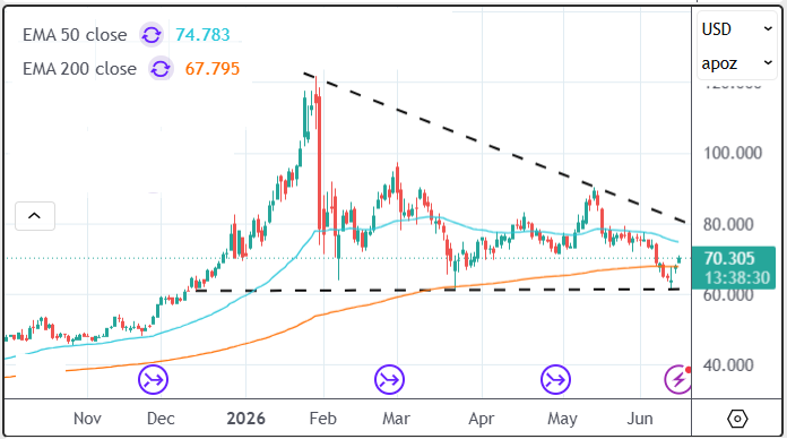
Silver’s ability to sustain trade above $70 has opened the door to the $72–$75 range. Critical support sits at $60–$61. Industrial demand headwinds and FOMC uncertainty keep the near-term bias cautiously constructive. If prices sustain above $78-80 resistance, a new bullish rally would resume in Silver.
MCX Silver Spot
Disclaimer: This report contains the opinion of the author, which is not to be construed as investment advice. The author, Directors, and other employees of Augmont Goldtech Pvt. Ltd; Augmont Enterprise Ltd. and its affiliates cannot be held responsible for the accuracy of the information presented herein or for the results of the positions taken based on the opinions expressed above. The above-mentioned opinions are based on information which is believed to be accurate, and no assurance can be given of the accuracy of the information. The author, directors, other employees and any affiliates of Augmont Goldtech Pvt. Ltd; Augmont Enterprise Ltd cannot be held responsible for any losses in trading. In no event should the content of this research report be construed as an express or implied promise, guarantee or implication by or from Augmont Goldtech Pvt. Ltd; Augmont Enterprise Ltd., that the reader or client will profit, or the losses can or will be limited in any manner whatsoever. Past results are no indication of future performance. The information provided in this report is intended solely for informative purposes and is obtained from sources believed to be reliable. The information contained in this report is in no way guaranteed. No guarantee of any kind is implied or possible where projections of future conditions are attempted. We do not offer any sort of portfolio advisory, portfolio management or investment advisory services. The reports are only for information purposes and are not to be construed as investment advice.


