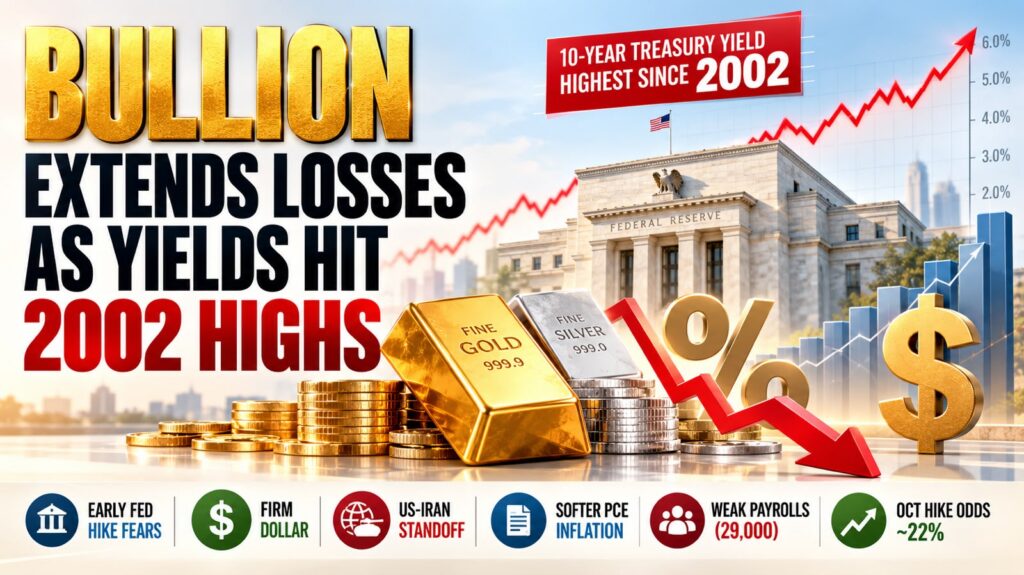
Early Fed hike fears, a firm dollar and Treasury yields at their highest since 2002 drove the selling in the precious metals pack. Softer PCE inflation and a weak 29,000 September payrolls print cut October hike odds to about 22%, but rallies above $4,200 faded. The US-Iran standoff kept oil and rate expectations elevated. This week, the RBI policy on 7 October, Fed speakers and US data are key, with gold support at $4,110 and then the psychological $4000 mark.
PRICE PERFORMANCE
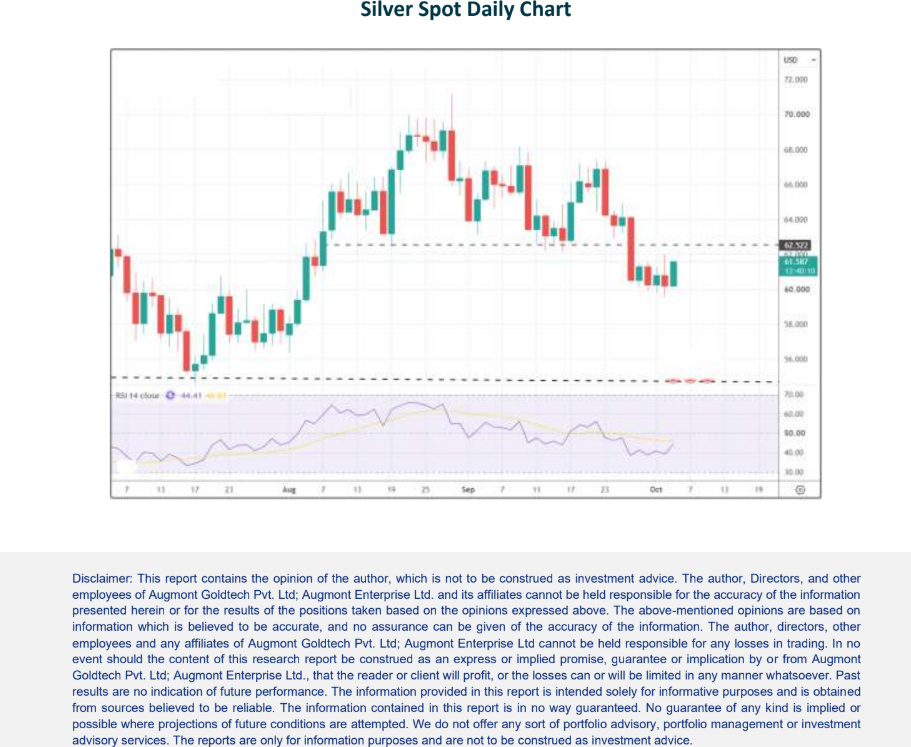
It was a bruising week for precious metals. Spot gold shed 3.4% to close at $4,140, marking a second straight weekly loss. A near-4% slide on Monday dragged prices to a seven-week low of $4,110. Silver had it worse. It fell 6.1% to $60.37 and briefly dipped below $60 on Friday, touching $59.69. A wider sell-off in industrial metals hurt, and so did silver’s sharper sensitivity to rate expectations. That pushed the gold-silver ratio to roughly 68.6, up from 66.6 a week earlier.
MACRO BACKDROP & FED POLICY
The Fed set the tone from the start. On Monday, CME FedWatch showed traders pricing about a 70% chance of an October rate hike. Brent was climbing back toward $106 and the 10-year Treasury yield had pushed past 5.2%. That knocked gold down almost 4% in
a single session, its steepest one-day fall since 10 June.
By midweek, the mood had shifted. Wednesday’s August PCE inflation reading came in softer than expected, and the previous month was revised lower, pulling October hike odds down to about 31%. Friday’s payrolls added to that. The US created only 29,000 jobs in September, well short of the 90,000 forecast, while August was cut to 133,000. With at least two Fed officials now openly opposing another hike, FedWatch odds dropped to around 22%. Gold jumped more than 1% above $4,200 on the jobs miss, but sellers stepped back in before the close.
GEOPOLITICAL TENSIONS
The US-Iran standoff kept oil, and inflation expectations along with it, on edge. O Monday, President Trump turned down Iran’s proposal to reopen the Strait of Hormuz, pushing crude higher and feeding the rate-hike narrative. This conflict has hurt gold rather than helped it. Bullion is down more than 20% since the US-Israeli war with Iran began in late February, as markets have treated war-driven energy inflation as a reason for tighter policy, not as a cue to buy safe havens. Pressure eased later in the week as Gulf crude shipments moved closer to pre-war levels after Saudi Arabia restored half the capacity of its East-West pipeline, although China’s suspension of oil product exports on Thursday briefly stirred supply fears again.
CURRENCY MOVEMENT
The Dollar Index rose 0.9% to 101.92, its third weekly gain in a row, after hitting a 14- week high of 102.21 on Thursday. That same day, US 10- and 30-year Treasury yields climbed to their highest since 2002, making a non-yielding metal costlier to hold. Fiscal concerns in France dragged on the euro, lifting the dollar further. If the DXY holds above 102, bullion could come under fresh pressure.
USDINR rose 0.5% to 96.30 after touching 96.33. A strong dollar and a hefty oil bill kept the rupee under strain, leaving it more than 6% weaker this year. The RBI has been selling dollars in both the spot and NDF markets. Forex reserves fell $18.34 billion to $747.56 billion in the week to 25 September, a third straight weekly drop, with gold reserves down $2.59 billion in value. The RBI announces its policy on Wednesday, 7 October, and a 25 bps hike is widely expected.
INVESTMENT AND RETAIL DEMAND
ETF demand was strong heading into September. Global gold ETFs drew $18 billion (121 tonnes) in August, taking holdings to a record 4,189 tonnes, and Europe posted its best month ever. The WGC’s September data, due shortly, will reveal whether last month’s 6% price drop sparked redemptions. In India, gold ETF inflows climbed 67% to ₹2,597 crore in August, even as new investor accounts slowed sharply.
WEEK AHEAD
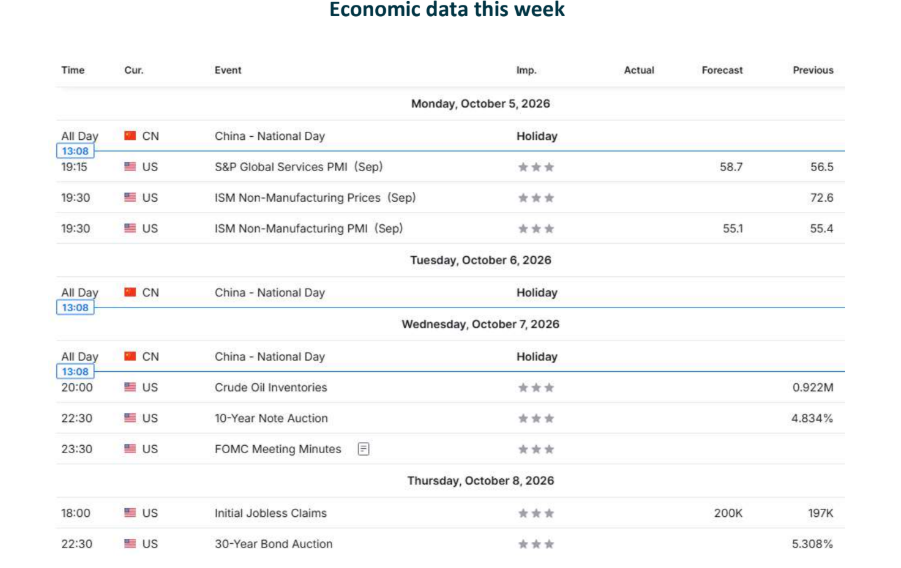
This week, watch the RBI decision on 7 October, Fed speakers, US trade data, the University of Michigan sentiment survey, and any movement in US-Iran talks. Weaker US data and fading hike bets give gold a chance to stabilise, but a firm dollar and yields above 5% should keep any rally in check.
TECHNICAL OUTLOOK
Gold sits below its 100-day moving average, and the short-term trend remains weak as long as prices stay under $4,250–4,300. Support is at $4,110, last week’s low, followed by the psychological $4,000 level. On MCX December gold, watch support near ₹1,48,500 and resistance near ₹1,51,000. For long-term investors heading into the festive season, dips toward $4,000–4,100 (roughly ₹1,45,000–1,48,000 on MCX) look like sensible zones for staggered buying.
For silver, $57–60.00 is the key floor and $62.50 is capping rallies. On MCX, silver has support around ₹2,20,000 –₹ 2,25,000 and resistance near ₹2,30,000.