
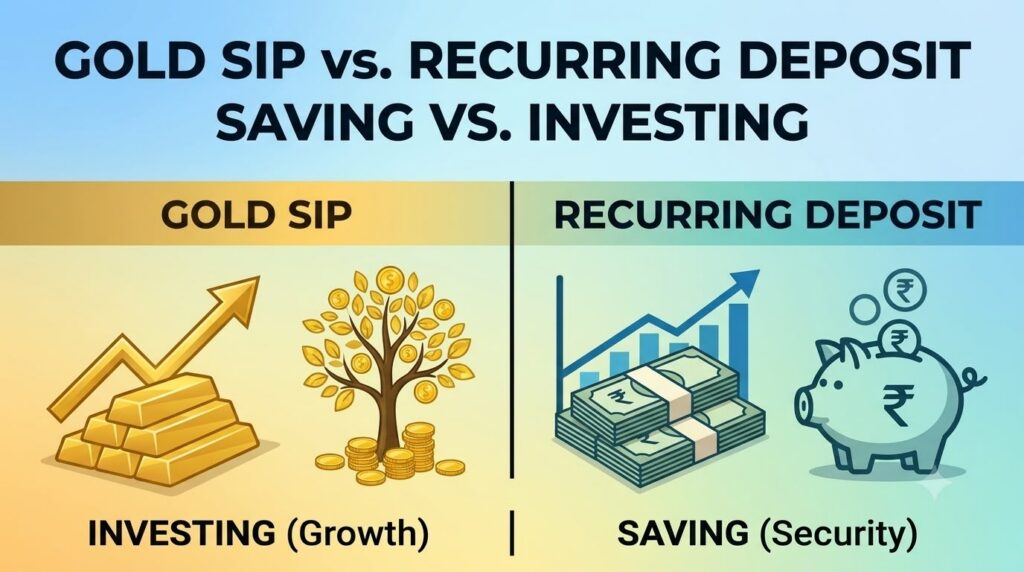
Building wealth often begins with a simple habit: setting aside a fixed amount of money regularly. While traditional savings options such as Recurring Deposits (RDs) help individuals accumulate money over time, a Gold Systematic Investment Plan (SIP) offers a different approach by allowing them to invest in gold through regular contributions.
Both options encourage financial discipline, but they differ in how they work, how returns are generated, and what they can contribute to an individual’s financial goals. Understanding these differences can help investors decide whether a Gold SIP fits into their long-term financial plans.
Gold SIP: An Overview
A Gold SIP allows individuals to invest a fixed amount in gold at regular intervals, such as weekly or monthly. Instead of purchasing a large quantity of gold at once, investors accumulate smaller quantities through consistent contributions. Depending on the platform and product structure, digital gold investments can begin with relatively small amounts, making gold accessible to individuals with different budgets. Investors can purchase gold digitally without the need to store physical coins or jewellery themselves.
One of the key advantages of a Gold SIP is the ability to invest consistently, regardless of short-term price movements. When gold prices are lower, a fixed contribution purchases more gold. When prices rise, the same contribution purchases less. Over time, this approach spreads purchases across different price levels, although it does not guarantee profits or prevent losses.
Recurring Deposit: An Overview
A recurring deposit is a savings product offered by banks and certain financial institutions. It allows individuals to deposit a fixed amount at regular intervals for a predetermined period and earn interest at an agreed rate. However, the returns depend on the applicable interest rate, tenure, taxes, and withdrawal conditions. Unlike a Gold SIP, an RD does not provide exposure to gold prices or the potential benefits of holding a precious metal.
Gold SIP vs Recurring Deposit: Understanding the Differences
The primary difference between these options lies in their purpose. An RD focuses on disciplined savings and predictable interest earnings, while a Gold SIP focuses on gradually accumulating gold as an investment.
A Gold SIP may also help investors diversify their portfolios by adding exposure to a precious metal. However, gold does not generate interest income simply by being held, and its future performance is not guaranteed.
Why Consider a Gold SIP?
For individuals interested in gold, a SIP offers a structured way to build a holding over time instead of making a single large purchase. Regular contributions can make investing more manageable while reducing the pressure of trying to identify the ideal time to buy.
Gold also has a long history of cultural and financial significance in India. Through a Gold SIP, investors can incorporate this asset into their financial plans without necessarily purchasing jewellery or coins.
Before investing, it is important to understand the product structure, applicable charges, storage arrangements, and selling process. Digital gold products may also have different protections and regulatory arrangements from exchange-traded gold products.
Final Thoughts
A Gold SIP offers a convenient way to accumulate gold through regular investments, while a Recurring Deposit helps individuals build savings through fixed contributions and interest earnings. Understanding their differences can help you choose an approach that matches your financial goals, time horizon, and comfort with uncertainty.
The key is to invest with a clear purpose, understand the product before committing money, and make decisions based on your overall financial needs rather than short term market movements.


