

Executive summary
Samvat 2082 will be remembered as two very different years squeezed into one. Gold printed a record of $5,595 an ounce in late January and silver went past $120, and then both spent the next nine months giving a large part of it back. Our view for Samvat 2083 is constructive on gold and cautiously positive on silver, with the first half of the year likely to be choppy. The US Federal Reserve is still leaning towards one more hike in December, oil is elevated because of the Iran conflict, and real yields are high. Against that, central banks bought 321 tonnes in the September quarter alone, gold ETFs are still taking in money, and the valuation premium that worried us in early 2026 has largely disappeared. Corrections of this size have, more often than not, been accumulation windows rather than the end of a bull market.
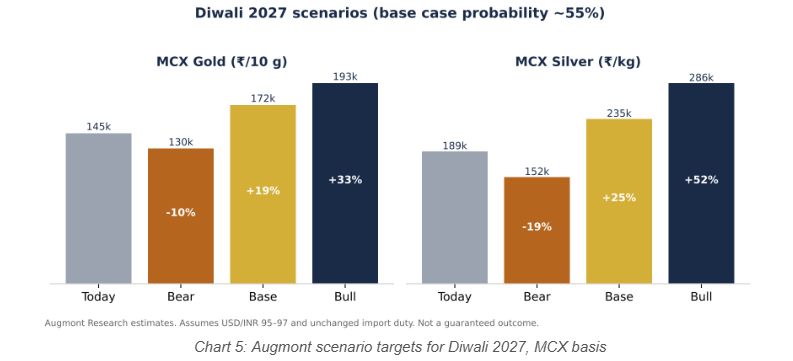
| Diwali 2027 view | Bear case | Base case | Bull case |
|---|---|---|---|
| International gold ($/oz) | 3,700 | 4,800 | 5,400 |
| MCX gold (₹/10 g) | 1,30,000 | 1,70,000–1,75,000 | 1,93,000 |
| International silver ($/oz) | 42 | 62–66 | 78 |
| MCX silver (₹/kg) | 1,52,000 | 2,30,000–2,40,000 | 2,86,000 |
| Probability (our estimate) | 20% | 55% | 25% |
Assumes USD/INR between 95 and 97 and no change to the current 15% import duty. Domestic prices are MCX basis, before GST.
Samvat 2082 in review: a record, then a reset
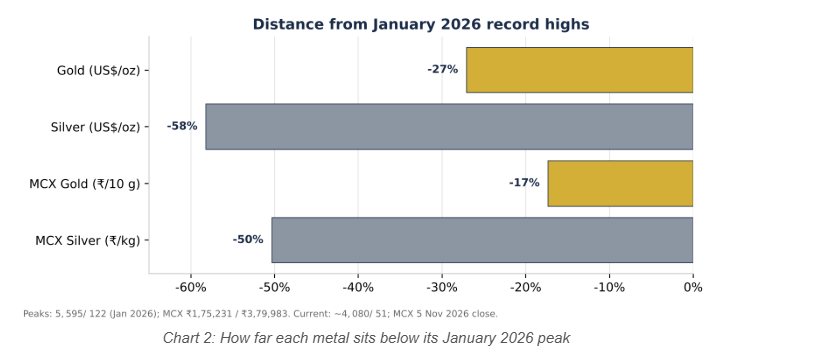
For an Indian household, the year still looks reasonable on paper. MCX gold is up roughly 15% since last Diwali and silver about 20%. The trouble is the path. Gold is down about 19% from its January high of ₹1.80 lakh per 10 grams, and silver has lost close to half its value from ₹4.20 lakh per kg. Anyone who bought in January is sitting on a loss; anyone who bought last Dhanteras is comfortably ahead.
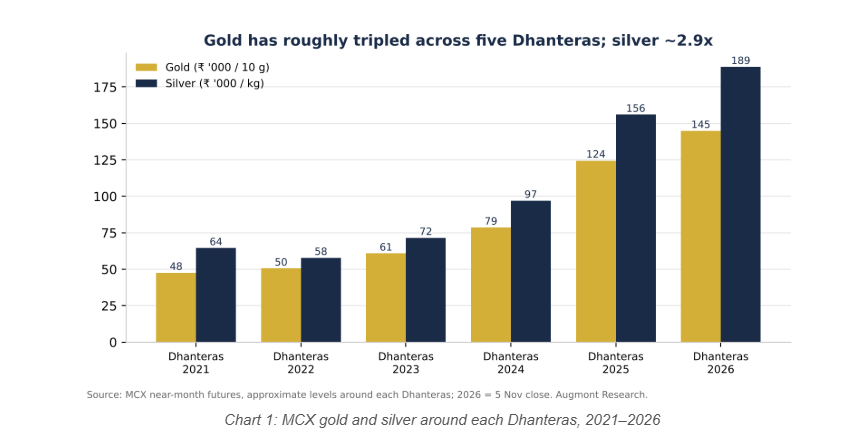
The longer picture matters more for a festive buyer. Gold has gone from about ₹47,600 on Dhanteras 2021 to roughly ₹1.45 lakh today, a compound return of nearly 25% a year. Silver has moved in a similar direction but with far deeper dips along the way.
Why prices fell
Three things did most of the damage, and they are connected. The first is interest rates. The US 10-year Treasury yield climbed from about 4.24% at gold’s January peak to 5.31% by early October, and the 10-year inflation-protected yield touched 2.92%, near its 2008 record. The Fed kept rates at 3.75–4.00% in October, but two members voted for a hike, and futures still price a December increase at roughly two-in-three odds.
The second is oil. The US–Iran war pushed Brent above $110 a barrel at points, which kept inflation sticky (US CPI was 3.7% in September) and made a rate cut look distant. Normally a war would help gold. This time the inflation channel outweighed the safe-haven channel.
The third is positioning. Gold and silver spent much of October trading like technology stocks. Over a ten-session window, the correlation between gold and Nasdaq 100 futures rose to about +0.77, and silver’s to about +0.71, while the usual inverse link with the dollar almost vanished. That pattern points to forced selling: funds cutting metals to cover losses in AI-linked equities. It also explains why the decline felt so mechanical.
India added its own pressure. The import duty was raised from 6% to 15% in May 2026, there were curbs on large fresh subscriptions to some gold ETFs, and the Prime Minister appealed to citizens to cut back on gold purchases to protect the current account.
What did not break
The buyers with the longest horizons kept buying through the fall. According to the World Gold Council, central banks added 321 tonnes in Q3 2026, up 42% from a year earlier and the highest quarter since late 2024. Year-to-date official buying reached 675 tonnes, and the Council now expects the 2026 total to at least match the 848 tonnes of 2025. China’s central bank extended its buying streak to 23 consecutive months in September, and Poland remained active.
ETF investors also stayed. Physically backed gold ETFs took in 211 tonnes globally in Q3, even with higher yields and a firm dollar, which suggests that worries about government debt are partly offsetting the higher opportunity cost. In India, gold ETFs saw ₹4,451 crore of net inflows in September, taking the year-to-date figure past all of 2025.
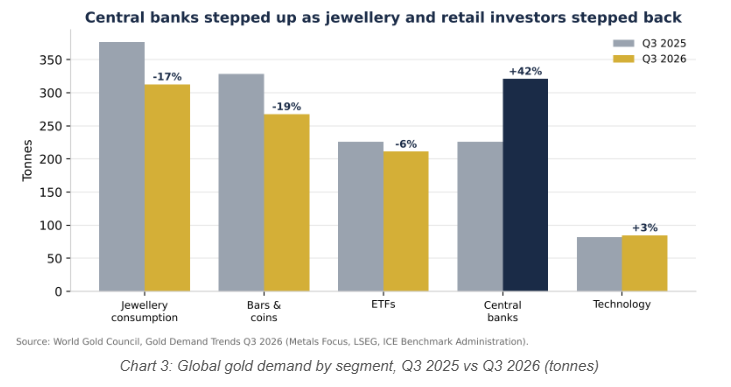
The weak spots were retail. Jewellery consumption fell 17% to 313 tonnes, the lowest third quarter since the series began in 2000, and bar and coin demand slipped 19%. That is what you would expect when prices run up 23% year-on-year in dollar terms.
India: fewer grams, more rupees
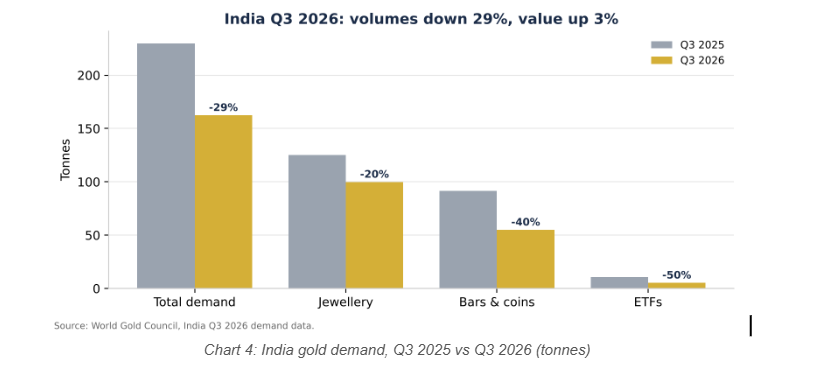
India’s Q3 demand dropped 29% to 162.5 tonnes, while its value rose 3% to ₹2,41,900 crore. Jewellery volumes fell 20%, bars and coins fell 40%, and net imports nearly halved. The WGC expects full-year demand of 625–675 tonnes, which would be a six-year low. On the ground, buyers are switching to lighter pieces, lower caratage and exchange schemes rather than walking away from gold entirely. Online platforms are reporting festive gold coin demand at roughly three times a normal day, which tells us intent is intact even when budgets are tight.
Silver: a deficit market under liquidation
Silver’s fall has been brutal. From roughly $122 in January it touched the high $40s in late October, and it is now trading about 29% below its 200-day moving average, the widest gap since March 2020. Those extremes have historically come near turning points, though they do not tell you the exact bottom.
The fundamentals are softer than last year but not broken. The Silver Institute’s World Silver Survey 2026 still projects a sixth consecutive deficit, of about 46 million ounces, even with total demand expected to slip 2%. The weak link is solar. Panel makers are thrifting silver and moving towards copper-based pastes, and photovoltaic silver demand is expected to drop by close to a fifth this year. Electrification, data centres and automotive electronics are filling part of that gap.
Two things are keeping prices down despite the deficit. ETF redemptions have released physical metal into the market, so near-term availability is comfortable. And because most silver is mined as a by-product of copper, zinc and lead, a forecast copper surplus in 2027 hints at steady supply. Silver usually needs gold to lead or copper to tighten before it can run. With the gold-silver ratio near 78–80, silver looks cheap relative to gold, but cheap can stay cheap for a while.
Key drivers for Samvat 2083
Safe-haven dynamics
Gold’s haven role has been bent, not broken. When equity markets suffer sharp drawdowns, gold often falls first as investors raise cash, then recovers once the forced selling ends. We saw this in 2008 and again in March 2020. The Democratic sweep in this week’s US midterms, and the 4% drop in the S&P 500 that followed, is a reminder that equity volatility can return quickly. If the AI trade unwinds further, the first reaction in metals may be negative, but lower yields and a softer dollar would build a better base for the second half of Samvat 2083.
Geopolitical developments
A ceasefire or deal between Washington and Tehran is, oddly, one of the more bullish outcomes for gold over a twelve-month view. It would pull oil lower, ease inflation, and give the Fed room to stop hiking and eventually cut. Prolonged conflict keeps oil high and delays that turn. Reserve diversification away from the dollar continues regardless, which is why official buying has held up through every price phase.
Macroeconomic signals
The single most important variable is the US real interest rate. Consensus forecasts point to a softer dollar and lower nominal Treasury yields by Q3 2027, and the firm’s model puts gold near $4800 in that environment. A hike in December that is clearly signalled as the last one would, in our view, mark the start of gold’s recovery rather than delay it. The rupee also matters. USD/INR has been trading near 94.6–95.0, and every one-rupee move adds or removes roughly ₹1,500 from the price of 10 grams.
Price outlook to Diwali 2027
Our base case assumes the Fed delivers one more hike, holds through the first half of 2027 and begins easing in the second half as oil cools. In that world gold should trade a wide ₹1,35,000–1,55,000 range through the March quarter and then build towards ₹1,70,000–1,75,000 by Diwali 2027, which is a 17–21% gain from today. Silver would lag in the first half and catch up later, reaching ₹2,30,000–2,40,000.
The bear case is a hiking cycle that runs into mid-2027 with oil above $110. Gold could then revisit ₹1,30,000, and silver could slide towards ₹1,52,000 as industrial demand weakens. The bull case combines a fiscal scare in US Treasuries with Fed cuts; gold would head towards ₹1,93,000 and silver could clear ₹2,80,000.
A note on India-specific risk: if the government reverses part of the May duty increase, domestic prices would drop overnight even if international prices did not move. A cut back to 6% would remove roughly ₹11,000–12,000 from the price of 10 grams at current levels. Buyers should keep this in mind, because it works against the rupee return on international strength.
Technical levels to watch in the shortterm
| Instrument | Support | Resistance | Bias |
|---|---|---|---|
| Spot gold ($/oz) | 3,875 / 3,790 | 4,120 / 4,250 | Neutral, turning up above 4,120 |
| MCX gold (₹/10 g) | 1,38,250 / 1,35,000 | 1,48,000 / 1,52,000 | Accumulate on dips |
| Spot silver ($/oz) | 48.50 /45.50 | 54.50 / 58.50 | Bearish below 54.50 |
| MCX silver (₹/kg) | 1,78,800 / 1,75,000 | 1,98,000 / 2,10,000 | Stagger, small lots |
Gold has reclaimed $4,000 after breaking below it in late October, and the $4,050–4,070 area, which lines up with the 38.2% retracement of the 2022–2026 rally, is now the line in the sand. Weekly closes above $4,120 would confirm that the low is in. Silver’s chart is weaker: lower highs, MACD below zero, and the 78.6% retracement of its 2025–26 rally just below current prices.
Investment strategy for Samvat 2083
Trying to pick the exact bottom has not worked this year and is unlikely to work in the next one. What does work is a plan.
- Allocation: hold 15–20% of financial assets in precious metals, split roughly 70:30 between gold and silver. Conservative investors can go 80:20.
- Timing: buy a third of your planned amount this Dhanteras and spread the rest over six to nine months through a SIP in gold ETFs, gold funds or digital gold. Add more aggressively if MCX gold dips towards ₹1,35,000 or silver towards ₹1,75,000.
- Silver: treat it as a diversifier with higher volatility (typically 1.5 to 2 times that of gold), not as a shortcut to returns. Accumulate in small lots.
- Format: for wearing and gifting, choose BIS-hallmarked jewellery and compare the full bill, including making charges, GST and buyback terms. For investment, coins, ETFs and digital gold avoid making charges and are easier to sell.
- Traders: keep positions light ahead of the December FOMC and use the levels above with strict stop-losses.
Risks to our view
The biggest risk is a Fed that keeps hiking into 2027 because oil-driven inflation refuses to fade. Other risks include a sharp rally in the dollar, a cut in Indian import duty, heavy central-bank selling by countries that need liquidity (Russia and Turkey both reduced holdings this year), and a deeper slowdown in solar demand that weighs on silver. On the upside, the risks are a fast resolution in the Middle East, a fiscal scare in US bonds, or a renewed wave of institutional buying from Chinese insurers, Indian pension funds and stablecoin issuers such as Tether.
Our closing thought for investors this Diwali: the price has reset, the reasons to own gold have not. Buy steadily, keep silver in proportion, and give the position the full year to work.


