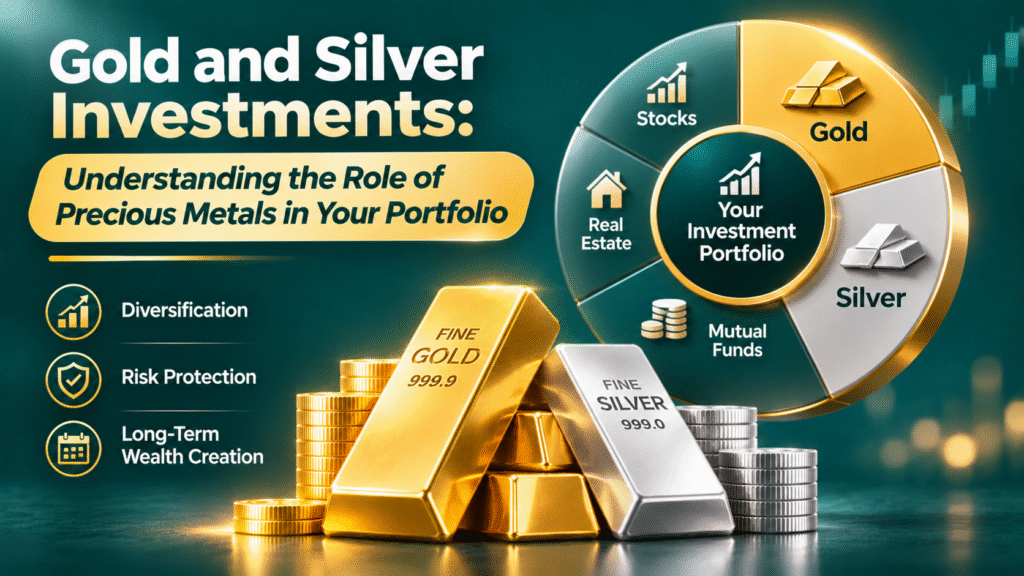
Gold and Silver have been valued for their beauty as well as their economic importance. Even today, they continue to attract investors looking for diversification and exposure to the precious metals market. Both metals can be investment assets, but they have different characteristics, price drivers, and potential uses. Understanding these differences can help investors make better choices about where they fit into an overall investment strategy.
Gold vs. Silver: What Makes Them Different?
Gold and Silver are often grouped together as precious metals, but they behave differently as investments. Gold is primarily viewed as a store of value and a portfolio diversification asset. Its demand is influenced by investment activity, jewellery consumption, central-bank purchases, interest rates, inflation expectations, and global economic conditions.
Silver, meanwhile, has both investment and industrial demand. It is used in areas such as electronics, solar technology, automotive applications, and other industrial processes. This means Silver prices can be influenced by both financial-market sentiment and changes in industrial activity.
These different demand profiles can lead to different price movements for the two metals.
Why Consider Gold as an Investment?
Gold can be particularly relevant for investors looking to build a diversified portfolio with exposure to an asset that has global demand and a long-established role as a store of value. Modern investment options have also made it easier to invest in Gold without necessarily purchasing jewellery or storing large quantities of physical metal. However, Gold prices can fluctuate, and past performance does not guarantee future returns.
Why Consider Silver?
Silver offers a different investment proposition. Alongside its role as a precious metal, it has substantial industrial applications. Growing demand from industries such as renewable energy, electronics, and advanced manufacturing can influence Silver consumption. At the same time, Silver can be more price-sensitive than Gold, which means its price may experience larger movements in both directions.
Physical, Digital, and Other Ways to Invest
Physical Gold and Silver can include coins, bars, and other forms of bullion. While tangible ownership can be appealing, investors also need to consider storage, security, purity, and transaction costs. Digital Gold provides another route for investors who want to accumulate Gold in smaller amounts without physically storing the metal themselves. Depending on the provider, Digital Gold products may offer different purchase, storage, and redemption arrangements, so investors should understand the applicable terms before investing.
Which Is Better: Gold or Silver?
If your priority is a precious metal traditionally associated with wealth preservation and diversification, Gold may be more aligned with your objective. If you are looking for exposure to a metal with both precious-metal and industrial demand, Silver may offer a different opportunity. Rather than choosing based solely on recent price performance, consider how each metal fits into your broader financial plan.
Final Thoughts
Gold and Silver can both play a role in a diversified investment strategy, but they offer different characteristics. Gold is widely associated with long-term value and diversification, while Silver combines investment demand with extensive industrial applications. The key is not necessarily choosing one over the other. It is about understanding why you are investing, how much volatility you can accept, and how precious metals fit into your overall portfolio


