Geopolitical events can have a significant impact on financial markets, often creating uncertainty that influences investor behaviour. Conflicts, elections, trade disputes, sanctions, and changes in international relations can affect currencies, commodities, and investment markets. Among these, gold and silver are closely watched because they can respond to shifts in economic sentiment and global risk.
Understanding this relationship can help investors make sense of why precious metals sometimes experience sharp price movements during periods of geopolitical uncertainty.
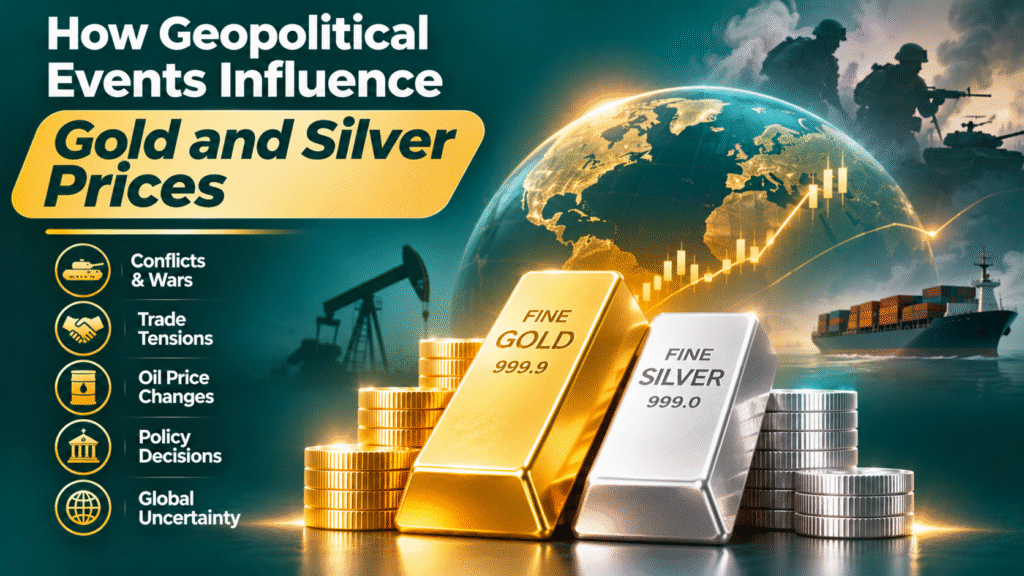
- Why Geopolitical Uncertainty Can Support Gold: Gold has traditionally been viewed as a store of value during uncertain times. When investors become concerned about economic stability, political tensions, or financial market volatility, some may increase their exposure to gold. This rise in demand can contribute to higher gold prices. However, gold does not automatically rise whenever a geopolitical event occurs. The scale and duration of the event, its potential economic consequences, and broader market conditions all influence how prices respond.
- The Role of Investor Sentiment: Financial markets react not only to what happens but also to how investors perceive future risks. A sudden escalation in geopolitical tensions can trigger a shift away from riskier assets toward assets that investors consider relatively defensive. Gold often benefits from this change in sentiment. If uncertainty persists, continued demand can influence gold and silver prices over a longer period.
- How Silver Responds Differently: Silver can also attract interest during periods of uncertainty, but its price behaviour is influenced by more than investment demand. Silver has extensive industrial applications, including electronics, solar technology, and manufacturing. As a result, geopolitical events can affect silver through two channels. Investor demand may increase when uncertainty rises, while concerns about global economic growth can reduce expectations for industrial demand. This combination can make silver more volatile than gold.
- Currency Movements Matter: Geopolitical developments can influence currency markets, particularly the US dollar. Since precious metals are internationally traded in dollars, changes in the dollar’s value can affect their prices. A weaker dollar can make gold and silver relatively less expensive for buyers using other currencies, potentially supporting demand. Conversely, a stronger dollar can create pressure on precious metals. This means that the relationship between geopolitical events and metal prices is rarely straightforward.
- Inflation and Energy Prices: Geopolitical tensions can disrupt energy supplies, trade routes, or commodity markets. Rising energy and other commodity costs can contribute to inflationary concerns. Gold may attract investor interest when people are worried about the purchasing power of money. Silver can also respond to inflation expectations, although its industrial demand introduces additional factors.
- What Investors Should Keep in Mind: Geopolitical events are only one influence on precious metal markets. Interest rates, inflation, currency movements, central bank activity, industrial demand, and overall investor sentiment can also have substantial effects. Therefore, investors should avoid assuming that every conflict or political development will produce the same reaction.
Final Thoughts
Geopolitical uncertainty can influence precious metals by changing investor sentiment, currency expectations, inflation concerns, and economic growth forecasts. Gold often receives attention for its defensive characteristics, while silver’s combination of investment and industrial demand can lead to more complex price movements. Rather than viewing short-term changes in gold and silver prices in isolation, investors may benefit from considering the broader economic and geopolitical environment behind those movements.


