
Gold has always meant more to Indians than just an investment it is jewellery for a wedding, a coin gifted at a festival, a bar tucked away in a locker for a rainy day. But this deep attachment has come at a cost: most of that gold just sits idle, locked away, earning nothing, while India spends tens of billions of dollars every year importing fresh gold from abroad.
The Electronic Gold Receipt (EGR) is an attempt to fix this contradiction. In simple terms, an EGR is a digital certificate that represents real, physical gold sitting safely in a vault a certificate you can buy, sell, or trade on a stock exchange, just like a share, and convert back into gold whenever you want. It is India first serious attempt at building a proper “spot” gold market: regulated, transparent, and tradeable.
Background: How We Got Here
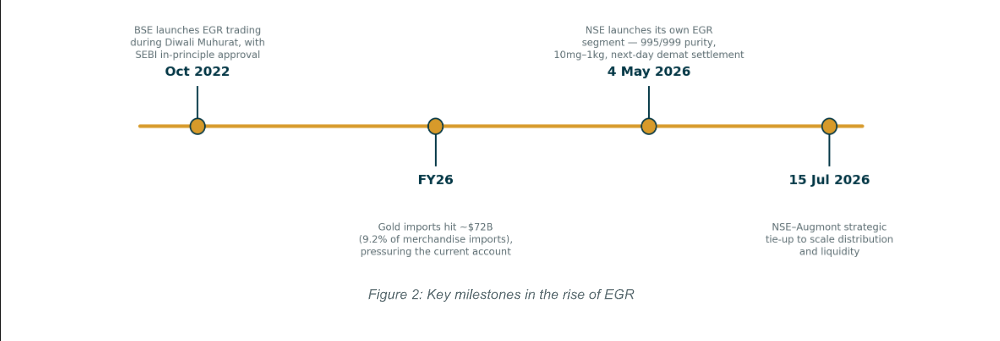
The idea of EGRs isn’t brand new. The BSE first launched EGRs back in October 2022, during Diwali’s Muhurat trading, after getting SEBI’s in-principle approval. But for nearly four years, adoption stayed limited most investors simply didn’t know the product existed, and structural hiccups (more on that below) discouraged serious use.
The picture began changing in 2026. On 4 May 2026, the National Stock Exchange (NSE) India’s largest exchange launched its own EGR segment, offering gold in 995 and 999 purity, in denominations as small as 10 milligrams and going up to 1 kilogram, tradable Monday to Friday, with settlement into a demat account the very next day. This gave EGR the scale and credibility it had been missing.
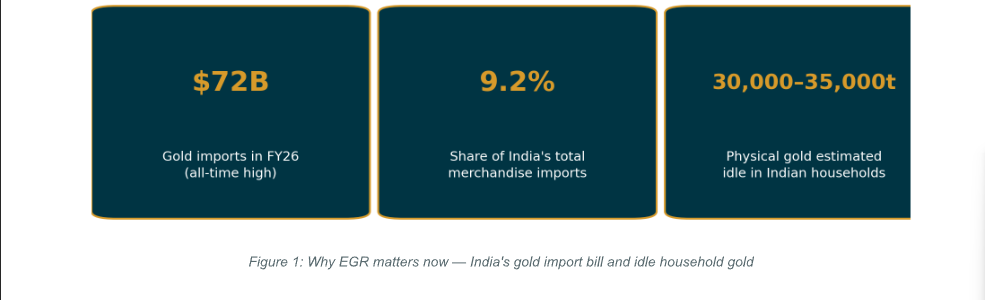
The timing mattered too: gold imports had touched an all-time high of nearly $72 billion in FY26, close to 9.2% of India’s total merchandise imports, putting real pressure on the country’s current account. Meanwhile, Indian households are estimated to be sitting on 30,000–35,000 tonnes of physical gold most of it doing nothing but gathering dust. EGR was designed precisely to connect these two facts: idle household gold on one side, and a nation that keeps importing more gold on the other.
How EGR Works — A Simple Example
Think of it like a locker-to-ledger conversion. Suppose you have 100 grams of gold bars sitting at home.
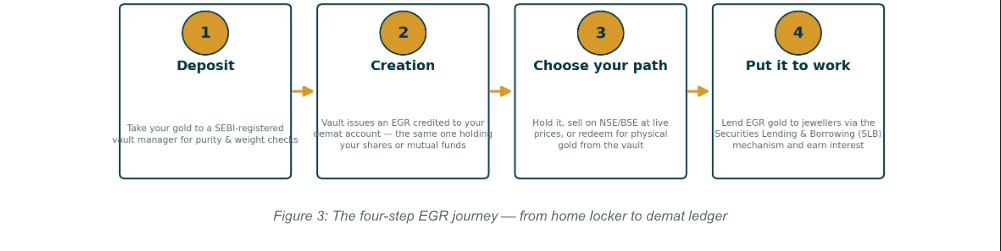
Step 1 — Deposit: You take the gold to a SEBI-registered vault manager (an accredited refiner-cum- custodian), who verifies its purity and weight.
Step 2 — Creation: Once it clears the checks, the vault issues an EGR a 3 tandardized 3 d security worth 100 grams of 999-purity gold credited straight into your demat account, the same account where you might hold shares or mutual funds.
Step 3 — Choose your path: You can hold it safely without worrying about theft or locker rent; sell part or all of it on the NSE or BSE at the live market price, just like a stock; or place a withdrawal request with the vault manager to get physical gold back within a few days, once the EGR units are extinguished.
Step 4 — Or put it to work: You can lend your EGR gold to a jeweller or manufacturer through the exchange’s Securities Lending and Borrowing (SLB) mechanism, earning interest on gold that would otherwise just sit in a drawer.
EGR vs Gold ETF, SGB, and Digital Gold
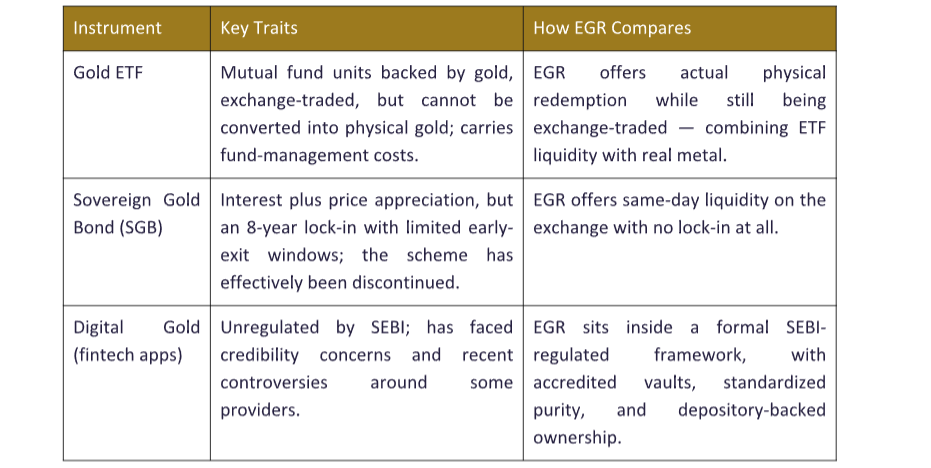
In short: EGR tries to combine the best features of all three exchange liquidity, physical convertibility, and regulatory safety into one instrument.
The Augmont–NSE Strategic Tie-Up
On 15 July 2026, NSE entered a strategic partnership with Augmont Enterprises Ltd, one of India largest integrated gold platforms, to give the EGR ecosystem real muscle. Augmont brings scale that few players can match:
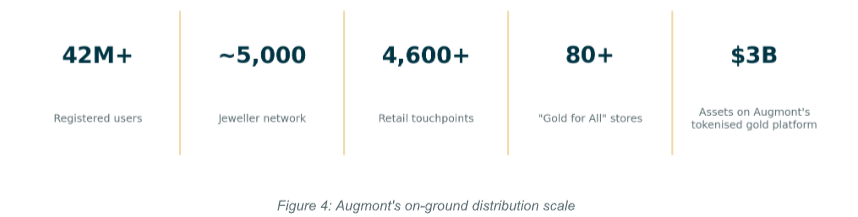
Under the partnership, Augmont will support EGR creation, redemption, liquidity provisioning, delivery, and price discovery essentially acting as the bridge between millions of ordinary gold buyers and the formal exchange ecosystem. Augmont leadership has pointed out that its own tokenised gold platform already manages close to $3 billion in assets, and expects EGR-linked assets to grow far larger over the coming years as the lending and jeweller-financing use case scales up
Way Forward and the One Speedbump
The biggest hurdle EGR still faces is tax-related, not technological. Buying physical gold attracts 3% GST. Converting that gold into an EGR, or trading the EGR, is GST-free but converting it back into physical gold triggers another 3% GST.
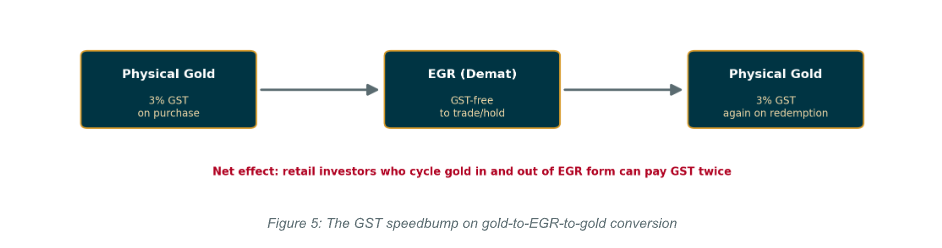
For registered jewellers, this can partly be offset through input tax credit, but ordinary retail investors get no such relief effectively paying GST twice if they cycle gold in and out of EGR form.

Beyond the tax fix, the road ahead includes expanding vault infrastructure to more cities, building investor awareness (most Indians still haven’t heard of EGR), integrating more brokers and depository participants, and linking EGR more closely with jewellery manufacturing supply chains through the SLB mechanism.
How India Stands to Benefit
If EGR genuinely succeeds at scale, the gains for India could be substantial:
- Lower import dependence: Even mobilising a small fraction of the 30,000–35,000 tonnes of gold lying idle in Indian homes could meaningfully cut the need for fresh imports.
- A healthier current account: Gold imports have been a major drag on India trade balance; reduced imports ease pressure on the current account deficit and the rupee.
- Better price discovery: A formal, exchange-based gold market means transparent, uniform pricing buyers in smaller towns get the same fair price as those in Mumbai.
- Formalisation of the gold trade: It brings unorganised, cash-heavy gold trade into a regulated, traceable system, improving tax compliance and investor protection.
- Productive household wealth: “Dead” gold becomes an income-generating asset through lending, without forcing anyone to give up their emotional attachment to owning real metal.
- Deeper financial market infrastructure: It strengthens India commodity-securities ecosystem, positioning NSE and BSE alongside established global bullion exchanges.
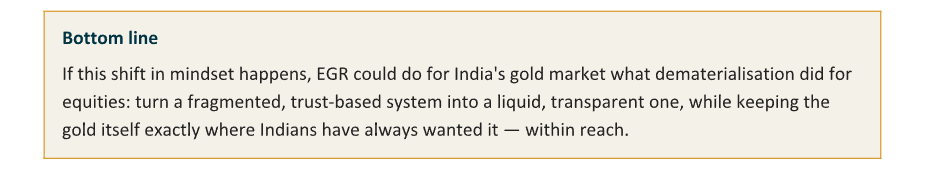
To sum up, EGR is not just another gold product it is India building the missing piece of its bullion market: a transparent, regulated, exchange-traded link between the metal Indians already own and the capital markets they increasingly trust. The building blocks are now in place regulatory framework, NSE exchange infrastructure, and Augmont on-ground distribution reach. What remains is execution: resolving the GST anomaly on redemption, deepening vault capacity, and most importantly convincing millions of gold-owning households that this is a compromise on tradition but an upgrade to it.

 – INDIA’S NEW WAY TO OWN GOLD)
 – INDIA’S NEW WAY TO OWN GOLD&description=&image=https://insights.augmont.com/wp-content/uploads/2026/08/ChatGPT-Image-Aug-1-2026-11_11_00-AM-1024x576.png)