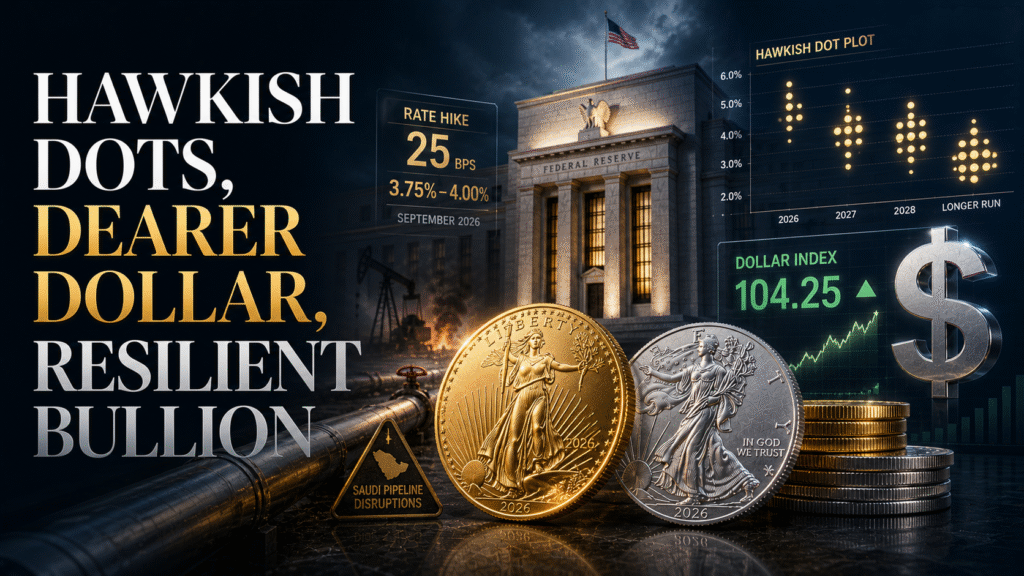
Gold and silver ended a shaky week higher after the Fed’s 25-basis-point hike to 3.75%– 4.00% came with a hawkish dot plot, while oil, driven by Saudi pipeline disruptions in the Iran war, set the tone for metals. In India, a weaker rupee at 95.863 amplified domestic gains, though jewellery demand stayed soft ahead of Dussehra and Diwali.
PRICE PERFORMANCE
The week started badly and finished well. Spot gold slid to $4,235 on Tuesday, then rallied to close at $4,378, up 0.67%. Silver did most of the work, gaining 2.7% on spot and 3% on COMEX. In rupee terms, MCX gold ended near ₹1.54 lakh per 10 grams and MCX silver near ₹2.41 lakh per kg. What makes this odd is that both metals climbed while the dollar index gained 1.1% and the US 10-year yield brushed 5%. Buyers stepped in on every dip, and a slide in oil from Wednesday gave them a reason to keep going.
MACRO BACKDROP & FED POLICY
The Federal Reserve raised rates by 25 basis points on Wednesday to 3.75%–4.00%, its
first hike since 2023. The 12–0 vote was fully priced in, so the real surprise was the dot
plot. Sixteen of 18 officials expect at least one more hike this year, the median year-end
rate moved to 4.1%, and the 2027 median jumped to 4.1% from 3.6%, wiping out the
cuts that had been pencilled in. Chair Kevin Warsh promised a “timelier” return to 2%
inflation, and CME FedWatch briefly showed about a 49% chance of another hike in
October.
GEOPOLITICAL TENSIONS
The Iran war is now in its seventh month, and this week its effect on gold worked through crude. A drone attack on 11 September shut Saudi Arabia’s East-West pipeline, the route that bypasses Hormuz. Houthi strikes on Saudi energy sites followed, and Oman postponed a planned Iran–Gulf meeting on Monday. Oil jumped, inflation fears grew, rate-hike bets hardened, and gold fell. Then the tone shifted.
Washington said the pipeline would restart within days. Saudi Arabia began moving extra cargoes to Asian refiners through ship-to-ship transfers near Oman, and reports emerged of China and Pakistan urging Iran to rein in the Houthis. Brent fell for three straight sessions but still settled near $105 on Thursday, with WTI holding around $102. Metals rose as oil came down. The lesson from this cycle is that war headlines lift gold only when oil doesn’t move with them, because higher oil currently means higher rates
CURRENCY MOVEMENT
The rupee weakened from 95.54 to 95.863 per dollar, a 0.34% move, and touched 96.10 on Thursday. Oil above $100 keeps importers hungry for dollars, and the Fed’s stance added to the pressure. The RBI and index-rebalancing inflows helped it recover from the lows, and May’s record of 96.965 remains intact.
INVESTMENT AND RETAIL DEMAND
Investment demand looks healthier. Indian gold ETF inflows rose 67% in August to ₹26 billion, and digital gold purchases are running near ₹25 billion a month. Import duty stays at 15%. With Dussehra in October and Diwali in early November, a dip toward ₹1.50 lakh
could bring buyers back. India, meanwhile, is in a wait-and-see mood. The World Gold Council notes that festive jewellery buying, which began in late August, has cooled since the August price spike, though wedding demand is holding steady. On 11 September, domestic gold traded at a discount of about $78 per ounce to import parity, nearly 2% below landed cost, because old-gold exchanges are keeping supply ample. Wholesalers say jewellers aren’t restocking.
TECHNICAL OUTLOOK
Spot gold is trading in a $4,250–$4,450 (~ Rs 150,000-154,000) range with a bullish bias. Buy on dips near support and sell into rallies. A break above the upper resistance could open the way to $4,600–$4,700 (~ Rs 160,000-165,000). Spot silver is trading in a $62.5–$67.5 (~ Rs 230,000-242,000) range, also with a bullish bias. The approach is the same: buy dips near support and sell rallies. A break above
resistance could take it toward $70–$71 (~ Rs 250,000).
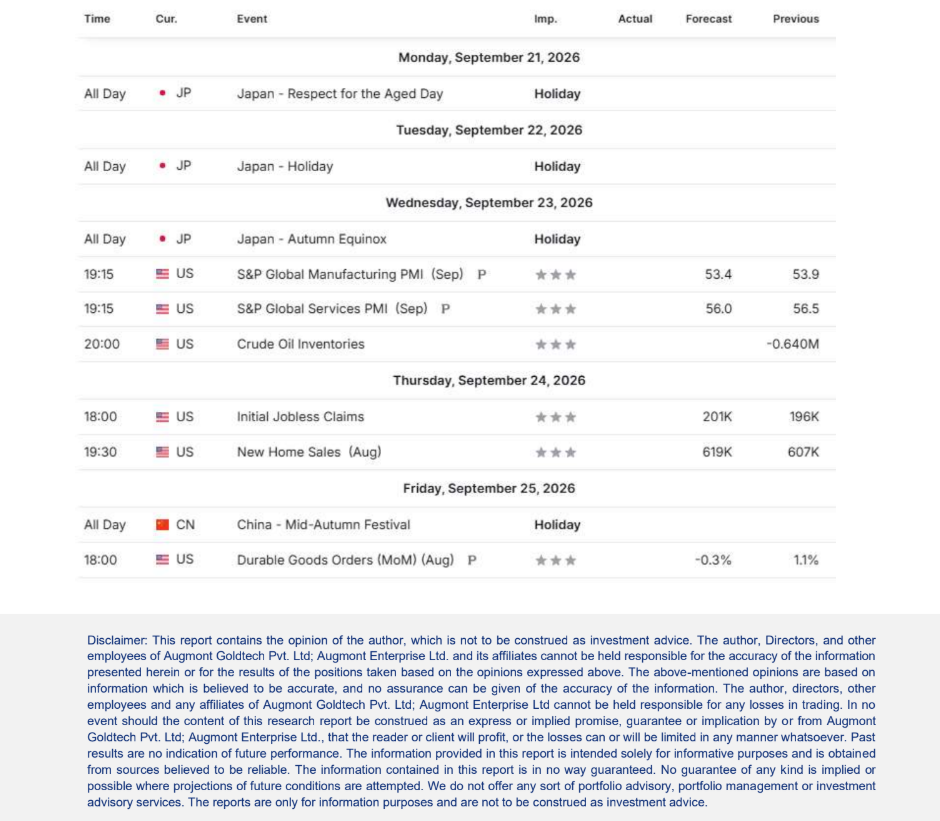
WEEK
AHEADThere are no important macro-economic events or speeches this week to eye for, but the geopolitical situation in Middle east would be closely watched.