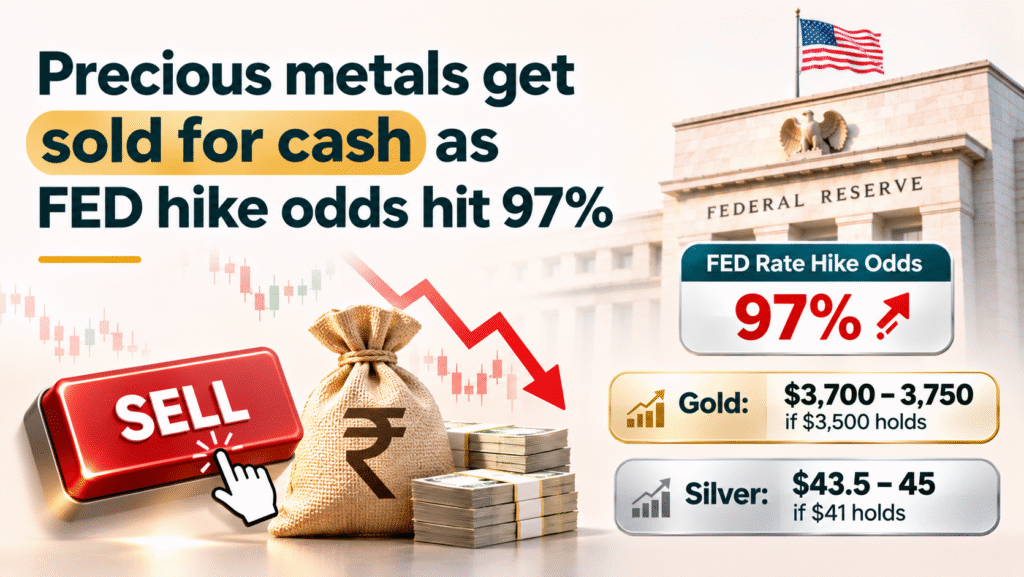
Gold and silver had a brutal week as investors raised cash. COMEX gold fell 9.5% to $3,515 and silver dropped over 16% to near $41. Hawkish Fed minutes, a 97% chance of a December rate hike, 10-year yields above 5.1% and a dollar near a 19-month high all weighed on prices. A selloff in AI stocks set off margin-driven selling, and Iran tensions gave no support. ETF holdings and central bank buying are holding steady. In a thin Thanksgiving week, oversold gold could bounce towards $3,700–3,750 if $3,500 holds. Silver could test $43.5–45 if $41 holds. A break below either level risk another 6–7% slide.
MARKET SENTIMENT: GOLD BECAME THE SOURCE OF CASH
Precious metals holders had a rough week. COMEX gold futures slid 9.5% to $3,515, and silver took a much heavier hit, falling more than 16% on COMEX to settle near $41. A hawkish Federal Reserve, a dollar trading close to a 19-month high and a sharp selloff in AI-linked technology stocks sent investors scrambling for cash, and gold and silver were among the easiest things to sell. The drop has cleared out most of the speculative excess, but there is little evidence so far of a durable bottom.
The Nasdaq lost 2.5% on Monday, and the slide in AI stocks only deepened after Thursday's closely watched Anthropic listing failed to revive confidence in the AI trade. In a typical risk-off week, some of that money would have gone into gold. This time,
investors sold gold to cover losses and meet margin calls elsewhere, so the metal fell right alongside equities and Bitcoin.
MACRO BACKDROP FED POLICY
Rates set the tone all week. Minutes from the Fed's October meeting, released on Wednesday, showed that nearly every policymaker expects more tightening to bring inflation back towards 2%. Gold dropped 3.2% that day. On Thursday, Philadelphia Fed President Anna Paulson said October pause was about the pace of hikes, not their direction. By Friday, CME FedWatch was pricing a roughly 97% chance of a 25 bp hike at the 8–9 December meeting. The 10-year Treasury yield is holding above 5.1%, and real yields are at their highest in more than two decades. When Treasuries pay thatmuch, it is difficult to make the case for a metal that pays nothing.
CURRENCY MOVEMENT
The Dollar Index rose 0.42% to close at 103.84, after touching 103.97 on Thursday, its highest level since April 2025. The gain was modest, but it added to the pressure on gold; rate differentials now clearly favour the dollar. The Indian rupee, meanwhile, had one of its strongest weeks of the year. USDINR fell 1.67% to 92.66, slipping below 93 for the first time in about seven months, as foreign money flowed into Indian equities while investors trimmed exposure to AI-heavy markets elsewhere in Asia.
GEOPOLITICAL TENSIONS
Iran risk still present, but gold got no support from it The US–Iran conflict, now in its ninth month, still matters for oil, yet this week it did
very little for gold. Mid-week, a New York Times report said Washington was weighing fresh strikes on Tehran, news that would usually lift gold. It barely registered. Talks over reopening the Strait of Hormuz have not produced a deal, but Gulf crude exports have largely recovered, and Brent is now trading in the low $90s, well below October's six-month high. Cheaper oil eases inflation worries and weakens gold appeal as a hedge. Even so, a sudden escalation remains the clearest upside risk for prices.
INVESTMENT AND RETAIL DEMAND
ETF investors have mostly stayed put. According to Saxo, global gold ETF holdings were broadly unchanged over the past month despite the price fall, a sign that longer-term investors are holding their positions. In India, gold ETFs recorded a fifth straight month of net inflows in October, and the World Gold Council estimates that another $262 million (about 1.75 tonnes) came in during the first ten days of November. Central banks are still buying, and they remain gold's strongest source of support. The World Gold Council reported 120 tonnes of central bank purchases in Q3 2026 and estimated a further 201 tonnes of unreported buying, some of it widely believed to be Chinese. The People Bank of China keeps adding to its reserves.
Thanksgiving (26 November) cuts the week short, so volumes will be thin and price swings could be sharp in either direction. After a 9.5% weekly fall, gold looks oversold on momentum indicators, so a short-covering bounce is possible. A lasting recovery, however, will probably need one of three things: a pause in the dollar rally, a softer November CPI print on 10 December, or a clear signal from Fed Chair Warsh that the hiking cycle is nearly over. Until then, we expect rallies to meet selling.
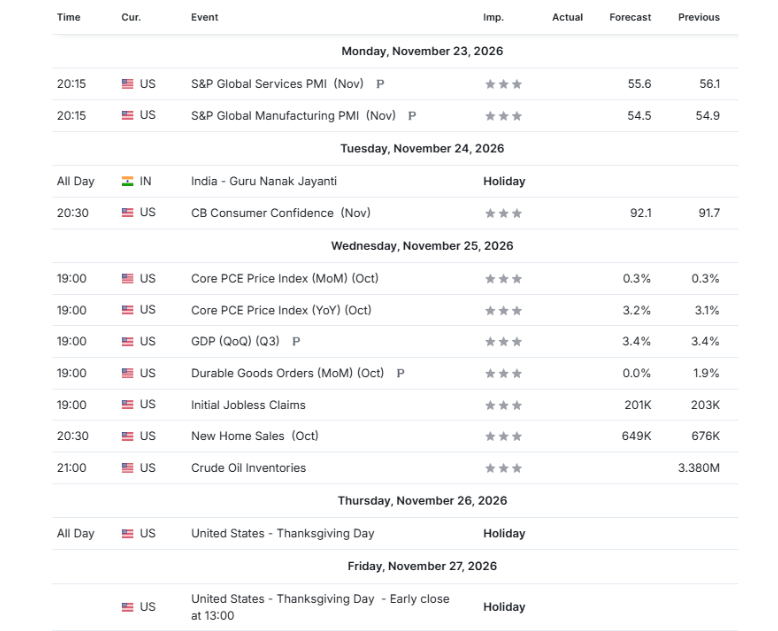
With gold in oversold territory, prices could rebound towards $3,700 and $3,750 this week, as long as support at $3,500 holds. A break below that level could open the door to a further 6–7% decline. Silver is also oversold and could recover towards $43.5 and $45, provided the $41 support holds. If that gives way, another 6–7% fall cannot be ruled out.


