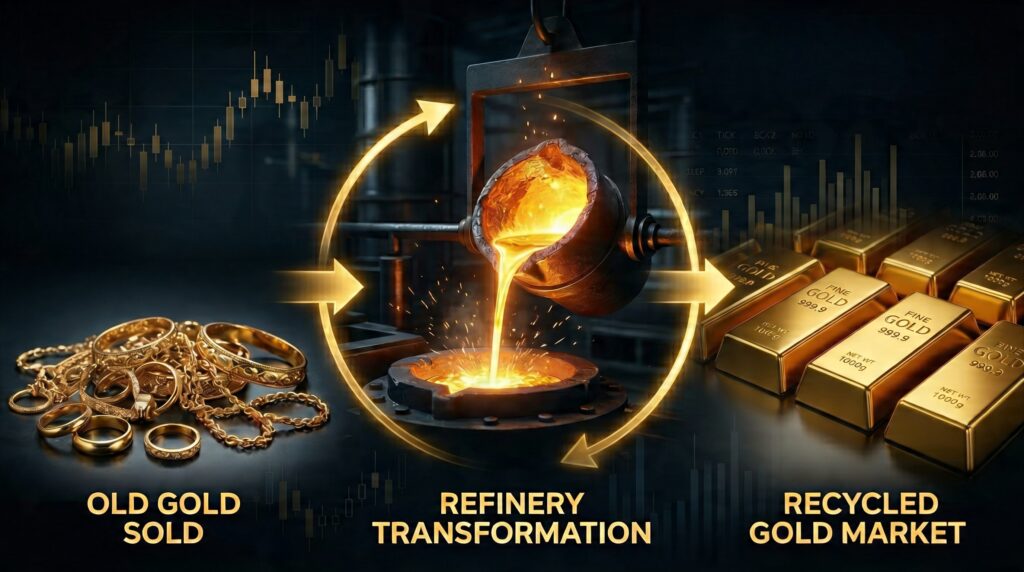
Many people decide to sell old Gold when they need liquidity, want to upgrade jewellery, or simply wish to unlock idle value. But have you ever wondered what actually happens after you sell it? Gold doesn’t disappear. It begins a structured recycling journey that keeps it in circulation and preserves its value.
Gold doesn’t lose value; unlike other metals, it can be recycled indefinitely without losing purity and strength. This ability makes Gold one of the most sustainable and regularly circulating asset classes in the world, apart from being precious. The moment you sell old Gold, it begins a structured journey of evaluation, refining, and redistribution that keeps it active within the economic ecosystem.
This blog explores the complete journey of gold after you sell old gold. It explains how the metal is processed, how it re-enters the market, and why recycling plays a vital role in maintaining long-term value and supply stability.
Stage One – From Evaluation to Refining
Once you sell old Gold, the process begins with assessment and purification.
- Purity Testing: The buyer checks the karat value to determine the amount of pure gold present.
- Weighing & Valuation: The net weight of gold is calculated after removing stones or non-Gold elements.
- Melting Process: The jewellery is melted at high temperatures.
- Refining: Impurities and mixed metals are separated to restore high purity levels, often up to 24K.
This stage ensures that the metal retains its core quality before re-entering circulation. One reason gold has remained valuable across centuries is that its physical properties remain unchanged even after repeated recycling.
Stage Two – Gold Finds Its Way Back Into the Market
Once refined, gold does not remain idle. It is carefully redistributed across different segments of the market, allowing it to continue creating value. Before understanding its new forms, it is important to note that recycled gold forms a significant portion of the global supply each year. This reduces dependency on fresh mining and supports a more sustainable cycle of demand and supply.
- Jewellery Manufacturing: Refined gold is often supplied to jewellery manufacturers to create new designs. The same gold that once existed as an old ornament can return to the market as a modern piece suited to current tastes.
- Investment Products: Gold is also minted into coins and bars for investors seeking physical assets. Many investment-grade products are made using recycled gold that meets strict purity standards.
- Institutional and Financial Demand: Refined gold supports financial platforms and bullion markets where it is traded as a store of value. Its liquidity and universal acceptance make it an essential part of the broader economic framework.
Through these channels, gold continues to circulate, preserving both liquidity and market stability.
Final thoughts
Gold is one of the few assets that never truly exits the system. It evolves, reshapes, and returns to the market in new forms while retaining its intrinsic value. When you sell old gold, you are not ending its journey. You are contributing to a cycle that keeps gold relevant, sustainable, and economically powerful. That enduring recyclability is what makes gold timeless and consistently valuable across generations.


